Stephanie Foti-Molinari
Artist and Arts Educator
Making
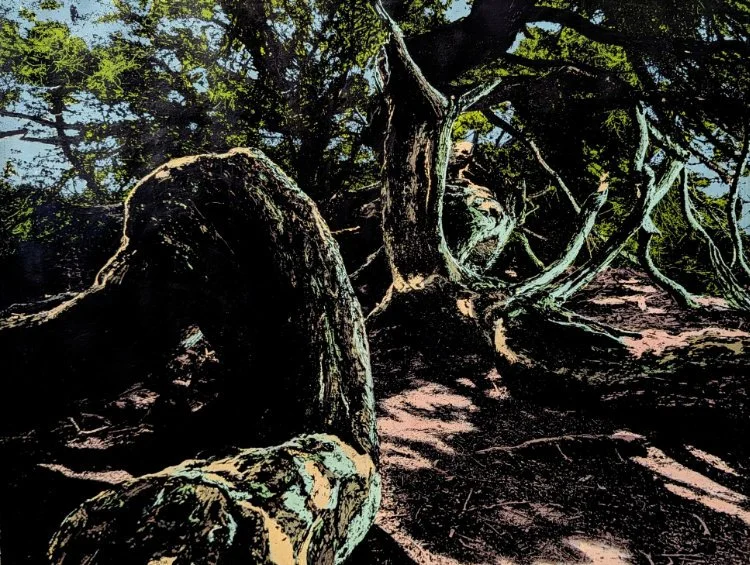
Stephanie Foti-Molinari is a multi-disciplinary artist and art educator based in Sonoma County, California. The through-line in Stephanie's work has been a desire to engage in a deeper understanding of the natural world, its ability to engender in humans a sense of awe and enchantment, the role this plays in our sense of place and memory, and art's ability to harness these traits as a call to action for preserving our wild spaces.
The artist's current practice is the creation of acrylic monoprints. Each artpiece evolves from a digital phototgraph to a tranfsfer onto a gel plate which is then manipulated with sgrafitto and brush strokes, before being printed on paper. Stephanie Foti-Molinari loves playing within the tension of opposition throughout her process: visual chaos vs. ordered systems in the natural world; realism vs. abstraction; digital artifact vs. the human hand.

Teaching
During my career as an art educator I have had the privilege of working with students in the studio setting, museums, and the k-12 classroom. I believe that each student is capable of making great art and I love working with each individual to expand their technical skills and to work through the creative process. Core to my teaching philosophy is that there is no failure and that in every creative act there is value. Within each artist is a scientist: we observe, collect data, ask questions, and we test those ideas through the use of our tools and materials - then repeat. Regardless of age or starting point, I believe it is instrumental to treat art education as a research practice. We build foundational knowledge of art concepts and techniques, we study the theme or concept of the project, examine how other artists have tackled the same ideas, then use student voice and choice to implement what we’ve learned in our work. I believe that in order to develop students into creative thinkers for the 21st century and the age of AI, it is important to introduce them to design thinking strategies. The use of design thinking in art education pushes students to think deeply about the 5WH questions and to make intentional choices about their techniques or use of materials when working within creative restraints, while still keeping learning student-centered. Every student will come to a lesson with their own experience, pre-conceived notions and preferences. When breaking a lesson into multiple research and exploration stages, they’re given the opportunity to engage, connect and make self-discoveries at each phase. Rather than instructing from a “right” or “wrong” approach, this methodology opens up a world of possibilities for students with diverse backgrounds, learning styles, minds, and bodies.
These processes are at their best when we create an environment of consistency, clear expectations, and respect for ourselves, our fellow students and our materials. As an instructor I work to foster community and develop student investment in their work and studio space, by learning student interests and motivations and by offering students positive reinforcement with challenges, brain breaks, tasks, or opportunities to share their work. Through modeling, discussion, and team or partner activities we develop the skills to support one another, voice both our triumphs and desires for improvement, and learn from our peers.
I satisfy my personal love of lifelong learning by attending workshops or conferences and participating in online seminars. It is my goal to continue to bring new knowledge and skills to my students, and to use these new discoveries as opportunity for cross-curricular learning and community building.